I would recommend Elena's Nature Collection Day Cream, which you can get through the NHS - you will need to obtain a prescription from your GP. I used this on both my children and it worked a treat. It is light so perfect to massage in all over as part of the bedtime routine. The lavender scent is very soothing, I am sure it's helped them relax and sleep better too.
I also used to infuse oats in the bath water (use old tights).
Otherwise, I made a blend of essential oils for my 10-year-old niece, including lavender and chamomile, which gets diluted in sweet almond oil at a concentration suitable for children. She really enjoys using it, which is great, because the treatment works better if you keep it up. And so far, it's proved positive. Result.
Friday, 6 September 2013

Cooking (direction 4): make your own
Ms Harris in her Book of Green Household Management


recommends making your own:
Now, I have tried to make yogurt before. I borrowed a friend's yogurt maker. It felt like a lot of faff for something I don't fancy that much myself, and it didn't taste better than the shop-bought variety. Often, if you make something at home, it tastes better than the stuff from the shop and you know what's in it, so it seems worth the effort. Not in this case. Although I would love to skip all the kids' yogurt pots. If only I lived in Chester where they recycle yogurt pots as well as plastic bottles! Sigh. Perhaps one day people will choose where they live on the basis of the school catchment area first and the recycling facilities second.
recommends making your own:
- yogurt
- bread
- pulses
- jams
Now, I have tried to make yogurt before. I borrowed a friend's yogurt maker. It felt like a lot of faff for something I don't fancy that much myself, and it didn't taste better than the shop-bought variety. Often, if you make something at home, it tastes better than the stuff from the shop and you know what's in it, so it seems worth the effort. Not in this case. Although I would love to skip all the kids' yogurt pots. If only I lived in Chester where they recycle yogurt pots as well as plastic bottles! Sigh. Perhaps one day people will choose where they live on the basis of the school catchment area first and the recycling facilities second.
As far as bread is concerned, I have mentioned before than we have a bread maker, which I never use anymore because the bread I make with it always goes stale. Slicing seems to be an issue. It's hard living with people who are even lazier than me! But it would be better to make our own as we could use organic ingredients, lessen the salt content and skip the plastic bag.
Preparing pulses (soaking, boiling, etc.) is something I used to do a little before we had kids. I must admit it really doesn't register on the radar at the moment. The crux of the matter is planning. Of course, it is quicker to do in the pressure cooker. I would gain in terms of transport but I do wonder about the energy consumption.
Jams: I mentioned before the occasional lemon curd, but again, it didn't taste that much nicer than a shop-bought one, especially as there are a lot of locally produced options in this case. And of course, no more Nutella for me - see previous post. Argh.
Preparing pulses (soaking, boiling, etc.) is something I used to do a little before we had kids. I must admit it really doesn't register on the radar at the moment. The crux of the matter is planning. Of course, it is quicker to do in the pressure cooker. I would gain in terms of transport but I do wonder about the energy consumption.
Jams: I mentioned before the occasional lemon curd, but again, it didn't taste that much nicer than a shop-bought one, especially as there are a lot of locally produced options in this case. And of course, no more Nutella for me - see previous post. Argh.
Beauty products (direction 2): reviews
I just had to tell you about this fabulous face cream I got from Boots, Good Things Face the Day Moisturiser.
Face The Day
So, OK, I'm supposed to be blending my own stuff, but I had some points spare and it was on offer, so... And I chose well. It's free from parabens etc., and it's got SPF 15, and it's lovely to use, smells nice, not too rich so perfect for face and neck. Plus, it comes in a 100ml tube so is lighter on packaging than the usual 50ml tubes or pots.
Another product I can recommend is Green People's Face Scrub.

It doesn't foam, which is disconcerting at first, but it is effective yet gentle for the skin. It really gives a good scrub (feels like ground apricot stone) but is nourishing at the same time.
Face The Day
So, OK, I'm supposed to be blending my own stuff, but I had some points spare and it was on offer, so... And I chose well. It's free from parabens etc., and it's got SPF 15, and it's lovely to use, smells nice, not too rich so perfect for face and neck. Plus, it comes in a 100ml tube so is lighter on packaging than the usual 50ml tubes or pots.
Another product I can recommend is Green People's Face Scrub.
It doesn't foam, which is disconcerting at first, but it is effective yet gentle for the skin. It really gives a good scrub (feels like ground apricot stone)
but is nourishing at the same time.
Callenbach's green triangle
I have been off the chocolate crepes for 5 weeks and, let me tell you, it's been a challenge. But after 3 people congratulated me for my pregnancy over the summer, when I am not pregnant, I could no longer kid myself that that flowery blouse that I stretched at the seams was shrinking in the wash. No, I have been expanding.
So time to cut back. Which gives me an opportunity to reflect on Callenbach's triangle. I came across this concept in The Lilypad List.


Here is what Marian Van Eyk McCain has to say about it:
'Ernest Callenbach speaks of what he calls "The Green Triangle". (...) The three points of the triangle are:
Saving Money
Caring for the Environment
Being Healthy
'Callenbach points out that whenever you do something beneficial for one of the points on that triangle, you will almost certainly be doing something beneficial for the other two as well, whether intentionally or otherwise.
'He gives the example of deciding to improve one's health, by eating less fatty meat and dairy products. Not only would such a decision lower one's chance of circulatory disease, and have a number of other health benefits as well, it would also save money, since meat and dairy products are relatively expensive items. Furthermore, such a decision would benefit the environment too. Meat production is one of the most wasteful uses of agricultural land and therefore takes up farm resources that could be better used in other ways.
'He goes on to explain that you can start at any point of the triangle and get the same result. When you do something beneficial for the environment, like walking or bicycling instead of driving, you are helping to cut down pollution emissions (...). But at the same time you are creating a benefit for your own health, since you will get more exercise. And of course by leaving your car at home you will save a lot of money on petrol, oil and care repairs.'
(Although, saving money by buying cheap clothes produced in sweat shops with synthetic fibres does not sound like a good starting point.)
Applied to my case, I have stopped eating chocolate crepes to lose weight, which is good for my health. I produce less waste as I don't need to dispose of the plastic packaging anymore, which is good for the environment, and I have saved £8.75!
So time to cut back. Which gives me an opportunity to reflect on Callenbach's triangle. I came across this concept in The Lilypad List.
Here is what Marian Van Eyk McCain has to say about it:
'Ernest Callenbach speaks of what he calls "The Green Triangle". (...) The three points of the triangle are:
Saving Money
Caring for the Environment
Being Healthy
'Callenbach points out that whenever you do something beneficial for one of the points on that triangle, you will almost certainly be doing something beneficial for the other two as well, whether intentionally or otherwise.
'He gives the example of deciding to improve one's health, by eating less fatty meat and dairy products. Not only would such a decision lower one's chance of circulatory disease, and have a number of other health benefits as well, it would also save money, since meat and dairy products are relatively expensive items. Furthermore, such a decision would benefit the environment too. Meat production is one of the most wasteful uses of agricultural land and therefore takes up farm resources that could be better used in other ways.
'He goes on to explain that you can start at any point of the triangle and get the same result. When you do something beneficial for the environment, like walking or bicycling instead of driving, you are helping to cut down pollution emissions (...). But at the same time you are creating a benefit for your own health, since you will get more exercise. And of course by leaving your car at home you will save a lot of money on petrol, oil and care repairs.'
(Although, saving money by buying cheap clothes produced in sweat shops with synthetic fibres does not sound like a good starting point.)
Applied to my case, I have stopped eating chocolate crepes to lose weight, which is good for my health. I produce less waste as I don't need to dispose of the plastic packaging anymore, which is good for the environment, and I have saved £8.75!
Friday, 23 August 2013
Book: How green are my wellies?
I read How Green Are My Wellies by Anna Shepard a few months ago and found it excellent.


It is divided in 12 chapters, one per month, so that the seasons inspire changes in one's habits: managing clutter, wardrobe challenge, spring clean, composting, grow your own, parties, holidays, water, thrift, office, cycling and Christmas. Each chapter contains further information, and cooking ideas.
You can also read Anna Shepard's Eco Worrier blog.
It is divided in 12 chapters, one per month, so that the seasons inspire changes in one's habits: managing clutter, wardrobe challenge, spring clean, composting, grow your own, parties, holidays, water, thrift, office, cycling and Christmas. Each chapter contains further information, and cooking ideas.
You can also read Anna Shepard's Eco Worrier blog.
Friday, 16 August 2013
Cooking: chocolate hazelnut spread DISASTER (direction 4)
On 09/06 I tried to make some chocolate hazelnut spread to replace Nutella. I started off with Paul Peacock's recipe in Precycle!, but based on only half of his ingredients, so just 200g of roasted hazelnuts.
Paul's recipe: 400g hazelnuts, 200g caster sugar, 50g cocoa powder.
My attempt: 200g hazelnuts, 75g sugar, 50g cocoa, + 50g milk powder as there is some in Nutella, but I guess that wasn't the best idea to produce something that keeps. Then I grew a bit desperate with the mixture so added 2-3 glugs of sunflower oil, 1 glug of maple syrup, 3-4 glugs of skimmed milk (even worse). That produces enough to fill 2 jars.
Just as well, as nobody ate the result apart from me (a quarter) and the rest grew mouldy. :(
Lesson 1: stick to lemon curd.
Lesson 2: stick to a recipe.
Paul's recipe: 400g hazelnuts, 200g caster sugar, 50g cocoa powder.
My attempt: 200g hazelnuts, 75g sugar, 50g cocoa, + 50g milk powder as there is some in Nutella, but I guess that wasn't the best idea to produce something that keeps. Then I grew a bit desperate with the mixture so added 2-3 glugs of sunflower oil, 1 glug of maple syrup, 3-4 glugs of skimmed milk (even worse). That produces enough to fill 2 jars.
Just as well, as nobody ate the result apart from me (a quarter) and the rest grew mouldy. :(
Lesson 1: stick to lemon curd.
Lesson 2: stick to a recipe.
Friday, 9 August 2013
Direction 5: Water saving

DH and DS2 in the beautiful clear Lake Annecy in July
From as far as I can remember, I have always considered water as precious. I grew up in France, and we have always had a water meter so the general policy was always to use water sparingly. For instance, I have never ever washed my car, with the exception of the windscreen - there are a lot of insects on French roads in the summer!
Yet, I remember my mum watering the French beans growing in my grandmother's garden with the hose, every evening throughout July. And she now uses a timed watering system for shrubs that are planted beneath a long balcony, sheltered from any rainfall; but at least she never waters the lawn, which has looked like a door mat since 2003.
France, like the UK, does not suffer from water shortage on the whole, but even during my childhood I was aware of periods of severe drought, and flooding and mud slides. Since I moved to the UK, things have been a little obscured by the fact that we don't have a water meter. Truth be told, if it doesn't hit the wallet, it barely registers. (More on Ernest Callenbach's green triangle another time.)
Still, in the past few years, even before the green living bug officially bit me, I was:
- taking showers rather than baths, using with a normal shower, not a power shower; I used to keep the water as a starting point for DH's bath but I don't anymore because DS2 keeps throwing things in it, like large bath towels and soft toys (very irritating), and I worry about the children falling in and drowning... The kids share a bath;
- turning the tap on only to rinse my mouth after I brushed my teeth, so definitely not keeping the water running whilst brushing my teeth.
- DH fitted a smaller bathtub and a water-efficient toilet with dual flush when we replaced the suite in the bathroom in 2008.
- I added a brick and a bag of granules to the old-school cistern of the downstairs toilet. From United Utilities' literature, I gather this saves us one litre per flush, x 3 times a day, x 300 days, that 900 litres a year - it's not bad.
- I collect the water that's been sitting in the pipe overnight to water my long-suffering house plants - inspired by a project by electricwig, from their 'nothing is lost' collection 2004/05. A lot of this ingenious duo's projects were inspired by green ideas.

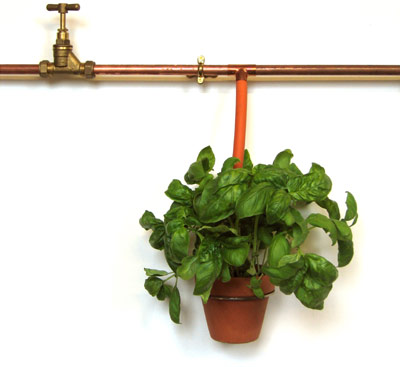
- I wash radishes and lettuce in the bowl of the salad spinner, rather than in the sink.
- We boil only one or two cups in the kettle at a time.
- I installed a clever tap adapter in the kitchen to turn the stream into a spray.
- We bought water-efficient Bosch washing machine and dishwasher. I'm a "rinser": the idea of eating washing-up liquid just doesn't do it for me, so a dishwasher made plenty of sense. (It was also a case of saving our marriage, and happily married people are supposed to be healthier than others. Perhaps I could get some funding from the NHS.)
- In hindsight, I am also glad we used a microwave steam steriliser for baby bottles and my breast pump: no chemicals, and only 200ml water needed. (But I don't know how well it compares in terms of energy consumption.)
- We also fitted a water butt next to the garage, but the gutter fell off! I'm proud to report that DH has now fixed this.
Spurred on by my research, when I received my water statement from United Utilities in March, I actually paid a bit of attention to the literature they enclosed. This is usually immediately consigned to the paper recycling bin, to the sound of my grumbling about wasted paper. But this time, I noticed they offered a free water saving pack. You know how sometimes you are working towards an objective and things conspire in that direction (rather than against it). There is a snappy proverb about this, but it doesn't come to mind.
I ordered the water saving pack from Save Water Save Money in April. It appears that it's not a deal reserved to United Utilities customers; lots of water companies are listed on that page, but I can only speak about the items I got.
- Save-A-Flush bag: we already have one downstairs. I am toying with the idea of fitting this one in the upstairs toilet, although it's an efficient model, to see how little water I can get away with. Having to flush several times would defeat the object. This is in addition to the Australian method (you know, if it's yellow etc.).
- Twin Tap Insert Kit: we haven't tried it yet because DH is not sure where he can fit it.
- Shower Regulator: we haven't tried it yet either.
- Toothy Timer: 2-minute hourglass to time tooth-brushing. We don't use it much because the children are little. Brushing DS2's teeth is more like Greek wrestling, I'm lucky if I can get the toothbrush in for 10 seconds, never mind 2 minutes. The crocodile cut-out is a waste of plastic in my opinion - plus crocodiles are not very pleasant animals. A lion would have been a more inspiring choice.
- 4-minute shower timer: now I love this product. I tried to use a kitchen timer before, but it didn't work, not precise enough. This timer on the other hand is great at finger-wagging in a quiet way. I confess I used to have leisurely showers, but not anymore. I am much more effective now, but I still find it impossible to get the water to the right temperature, soak my luscious locks, shampoo, exfoliate face, wash body, shave, scrub feet and rinse the lot in 4 minutes. Next step is the navy shower...
- I try very hard to teach the children not to waste water, for instance when they wash their hands. It's very difficult with DS2 who just loves playing with water, or in the water. So I hand-wash my scarves in a plastic washing-up bowl in the garden so he can play and do something useful at the same time - but then he steps in it with his shoes on. Is it his French blood telling him to practice crushing grapes under foot?
- Is it safe to use rain water in the paddling pool?
- I have tried to use water from boiled eggs or veg to water plants, but it's very fiddly. I don't have the opportunity much as eggs generally explode and we steam vegetables in the back steamer. Can't water plant with rice water although apparently you can use it to starch your clothes when ironing. I don't iron so I have not tested this.
- The new rule is we do not rinse plates. Our local council have kindly provided us with a compost carrier, which I use for cooked leftovers that I can't put in my compost bin, and so I careful scrape every crumb into that instead of just rinsing under the tap.
- I aim to convince DH that he should use rain water to wash the car now he's fixed the water butt. But as it's far from the drive and low to ground, he would need to use buckets.
- I am interested in using grey water from the basin and bath in the bathroom, just about the drive, for the same purpose. This would only happen once we've completely switched to soap-based products that are safe for the environment.
Subscribe to:
Posts (Atom)